Many businesses still treat PPC, SEO, and content as separate efforts. Because even the marketers do the same. Paid ads are handled by one team, SEO by another, and content is created without a clear performance goal. This siloed approach used to work, but it no longer delivers strong results.
Paid advertising costs are rising, organic rankings take time to build, and content struggles to perform without proper distribution. When these channels work independently, budgets are spent without fully understanding what is driving results. Important inputs from ads are not used in SEO, and high-performing content is not amplified through paid campaigns.
The problem is not the channels themselves. The problem is how they are used.
PPC, organic SEO, and content are most effective when they work together as one system. PPC provides immediate visibility and real user data. SEO builds long-term presence and trust in search results. Content supports PPC and SEO by answering user questions, building credibility, and guiding visitors toward taking a desired action.
When these channels are aligned, each one strengthens the other. PPC data improves keyword and content decisions. SEO reduces long-term dependence on ads. Content improves engagement, conversion rates, and maximizes return on investment or ROI.
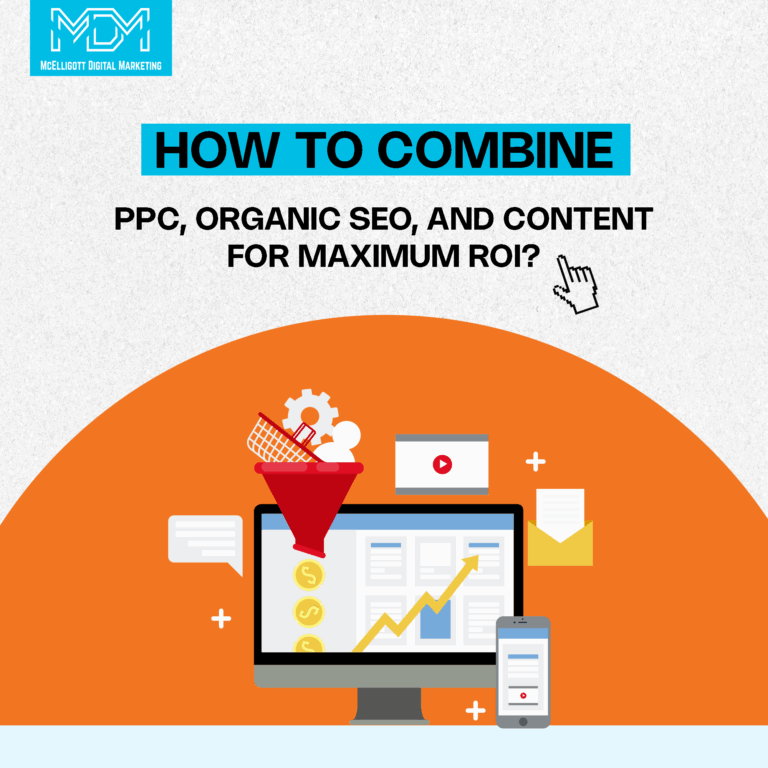
In this blog, we’ll tell you how to combine PPC, organic SEO, and content into a single strategy focused on measurable returns.
How does each channel work?
To combine PPC, organic SEO, and content effectively, it is important to understand what each channel does best.
1. Pay-per-click marketing
Pay-per-click ads, most commonly called Google ads, deliver results quickly. Once a campaign goes live, ads can start appearing within hours. This makes PPC ideal for testing new ideas, offers, and keywords.
Paid search also provides strong control. You can choose who sees your ads, when they see them, and which message they receive. More importantly, PPC ads generate real performance data. You can see which keywords convert, which ad copy works, and which landing pages drive action.
However, PPC has limits.
Traffic stops the moment you stop spending. Costs can rise quickly in competitive markets. This is why PPC works best as a testing and acceleration tool, not as the only growth channel.
2. Organic SEO
Search Engine Optimization focuses on building consistent visibility in search results over time. When pages rank well, they continue to attract traffic without ongoing ad spend. This makes SEO one of the most cost-effective channels in the long run.
Organic results also carry trust. Many users skip ads and prefer to click organic listings, especially for research-based searches. Strong SEO helps capture this intent at different stages of the buying journey.
The downside is speed. SEO takes time to show results. Rankings do not improve overnight, and content needs consistent effort to perform well.
3. Content marketing
Content sits at the center of PPC and SEO. Ads need landing pages and messaging. SEO needs useful, relevant content to rank. Without strong content, both channels struggle.
Good content educates users, answers questions, and builds credibility. It also takes visitors from awareness to conversion. When content is created with search intent and ad insights in mind, it becomes far more effective.
On its own, content rarely delivers ROI. But when supported by PPC and SEO, it becomes a powerful growth driver.
Why integrate PPC, SEO, and content?
The mistake businesses make is treating PPC, SEO, and content as separate strategies. Each channel is planned, executed, and measured on its own. The better approach is to build one strategy and use three channels to execute it.
At the core of this strategy is the business goal. This could be generating leads, increasing sales, or driving qualified traffic. Once the goal is clear, PPC, SEO, and content should all support the same outcome.
The audience is also the same across channels. The same user may see a paid ad today, read a blog post tomorrow, and return through an organic search next week. Treating these interactions as separate creates gaps in messaging and experience.
When the strategy is unified, each channel plays a specific role. PPC is used to test and accelerate. SEO is used to build long-term visibility. Content is used to educate, build trust, and move users through the funnel.
This allows data to flow across channels. High-performing PPC keywords guide what is to be prioritized in SEO. Strong organic pages reduce the need for constant ad spend.
Using PPC data to strengthen SEO and Content
One of the biggest advantages of PPC is the data it provides. Paid campaigns generate fast and clear insights about user behavior. When this data is shared with SEO and content teams, it removes guesswork.
Using paid keywords to validate SEO targets
PPC shows which keywords lead to form fills, sign-ups, or sales. This information is extremely valuable for SEO.
Instead of guessing which keywords to rank for, you can focus on the ones already proven to drive revenue. This reduces risk and speeds up SEO impact.
PPC also helps identify search intent. Some keywords look attractive but do not convert. Others have lower volume but higher intent. SEO efforts should be built around these insights.
Testing content messaging through ad copy
Ad copy acts as a real-time testing ground for content. Headlines, value propositions, and calls to action can be tested quickly through PPC ads.
When certain phrases consistently attract clicks and conversions, they can be reused in blog titles, meta descriptions, and page headings. This improves organic click-through rates and content relevance.
Improving SEO pages using landing page behavior
PPC landing pages tell how users interact with content. Metrics such as bounce rate, time on page, and conversion rate show what works and what does not.
If a landing page performs well in paid campaigns, its structure and messaging can be applied to SEO pages. If users drop off quickly, the content needs improvement.
Also read: How to maximize ROI using PPC ad extensions?
Using SEO and Content to reduce PPC costs
PPC becomes expensive if relied on for everything. This is where SEO and content come in. When used correctly, they help reduce ad dependency and improve campaign efficiency.
Ranking organically for high-cost keywords
Some keywords are expensive because they convert well. Businesses keep paying for these keywords month after month through ads. Over time, this becomes costly.
SEO can help here. Create high-quality pages that target these high-intent keywords, and you can get organic traffic for the same searches. Once rankings improve, paid spend is reduced. This does not mean stopping ads completely. It means using SEO to balance long-term costs.
Better content improves Quality Score
Search engines evaluate the relevance and experience of landing pages used in paid ads. Strong content improves user engagement and, thus, Quality Score.
When landing pages are clear, useful, and go with search intent, people stay longer and convert more. This leads to higher Quality Scores. It further lowers cost per click and improves ad visibility.
Retargeting visitors with PPC
Content attracts users who are researching or learning. These people do not convert immediately, but they are valuable prospects.
PPC is used to retarget these visitors with more focused offers. Since they already know the brand, they tend to convert at a lower cost. This makes paid campaigns more efficient.
Content mapping across the funnel
Content performs best when it is created with a clear purpose. Not every piece of content should try to sell immediately. Different people are at different stages of the buying journey, and content needs to match that intent.
This is where funnel-based content mapping becomes important.
1. Top of the funnel- Awareness content
At this stage, users are looking for information. They are trying to understand a problem or explore options. Blog posts, guides, and educational articles work well here.
SEO attracts this traffic, while PPC is used to promote high-value content or test new topics. The goal is visibility and trust, not immediate conversion.
2. Middle of the funnel- Consideration content
Here, users are comparing choices. They want more specific information. Case studies, use-case pages, comparison content, and in-depth resources are effective at this stage.
SEO helps you reach people who are actively searching for answers, and once again, PPC retargeting keeps your brand in front of users who have already shown interest.
Internal links guide them to more useful pages.
At this stage, what matters most is being clear, relevant, and trustworthy.
3. Bottom of the funnel- Conversion content
At the bottom of the funnel, people are ready to take action. They are looking for service pages, pricing information, demos, or contact options.
PPC is especially effective here because it allows precise targeting and strong calls to action. SEO supports this stage by ranking service and solution pages.
Content at this stage should remove friction, answer final questions, and make the buying step clear.
How to track ROI across channels?
When PPC, SEO, and content work together, measuring ROI is not as simple as checking one report. Real users do not behave in straight lines. They rarely click once and convert.
A common journey looks like this- someone reads a blog post, leaves, later sees a paid ad, clicks it, and finally returns through an organic search to convert. If you only look at the last click, you will assume organic search did all the work. That is not true.
This is where many businesses go wrong.
Instead of asking “Which channel converted?”, it is more useful to ask “How did the channels support each other?” Content introduces the brand. PPC brings people back at the right moment. SEO captures intent when people are ready to decide.
To track this properly, focus less on raw traffic numbers and more on outcomes. Look at cost per lead or cost per sale, not just clicks. Compare how users who read content behave versus those who land directly on a sales page. You will usually find that informed users convert better and cost less.
It also helps to watch trends over time. Content may not generate leads immediately, but it improves conversion rates across PPC and SEO later. Retargeting performance, assisted conversions, and repeat visits inform about ROI metrics.
Conclusion
Start with keywords that directly connect to revenue. Use PPC first to test which searches bring serious users, not just traffic. Once you see what converts, create content around those keywords and optimize it for SEO.
Over time, this reduces the need to pay for every click. Use PPC again to promote strong content and retarget visitors who have already shown interest.
Keep reviewing data from all channels together. Improve what works, stop what doesn’t, and focus on efficiency.
If your ads, SEO, and content are running in different directions, results will always feel inconsistent. Bringing them together requires planning, testing, and constant adjustment.
At McElligott Digital Marketing, we handle online promotion of businesses as one connected system. So, if you are not sure where to start, we can help.